
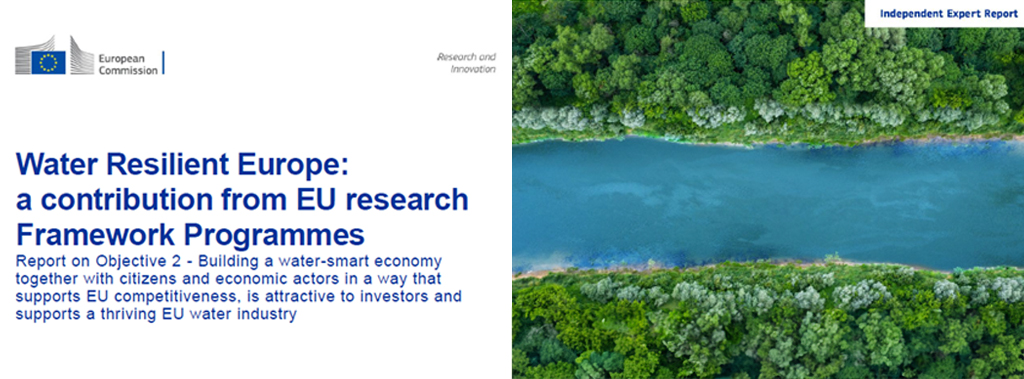
In the end of 2025, the European Commission released 3 independent reports, on the Water Resilience Strategy, to show how research and innovation are shaping the European water sector into a more circular and sustainable one. The REWAISE project was widely mentioned in the second report. Among the projects featured throughout the document, REWAISE appears repeatedly as a strong example of how digital tools, new business models, and decentralised solutions can reshape the way water is managed across regions and sectors.
According to the report, REWAISE stands out for its integrated approach to water circularity and for demonstrating new operational and governance models that shift utilities beyond the traditional “linear” supply scheme. The project’s Water‑as‑a‑Service (WaaS) concept is presented as a promising model for value‑driven, sustainable water services that combine digitalisation, resource recovery, and user engagement (p. 42).
Highlighting digitalisation and water‑smart services
One of the main themes in the report is the importance of digitalisation in enabling more efficient and resilient water systems. REWAISE is featured as a project that is actively deploying digital twins, IoT‑based monitoring, and smart metering solutions across its Living Labs to support real‑time decision‑making and predictive maintenance. These tools allow water utilities to detect leaks, manage demand more effectively, and optimise operations, strengthening the overall water resilience of cities and regions.
Demonstrating circular water solutions in real conditions
The European Commission highlights how REWAISE integrates technological innovation and circularity across multiple sectors. Several demonstrations are mentioned, including advanced pre‑treatment systems, resource recovery pilots, and decentralised reuse solutions tested in Living Labs across Europe.
In particular, the report points to examples where REWAISE technologies support industrial circularity. For instance, the project has collaborated with the dairy sector to implement digital twins and optimise water and resource use. These activities reinforce the project’s contribution to closing water loops and reducing the environmental footprint of industrial operations.
The Commission also references REWAISE’s involvement in testing anaerobic membrane bioreactors (AnMBRs) — a technology that enables simultaneous wastewater treatment, biogas production, and water reuse. Although the report summarises these efforts within broader discussions of innovation, AnMBRs are recognised as a key pathway for energy‑efficient treatment and circular resource recovery.
New business models and multi‑actor collaboration
Beyond technologies, the report emphasises REWAISE’s contribution to changing how water services are organised and financed. The project’s exploration of Water‑as‑a‑Service (WaaS) is highlighted as one of the most innovative aspects, proposing a more flexible and value‑based service model for utilities and end‑users. The Commission underlines that the WaaS approach supports the objectives of the Water Resilience Strategy even if the term itself does not appear in the Strategy (p. 42).
Another dimension recognised in the report is REWAISE’s strong stakeholder and citizen engagement. The use of Living Labs enables co‑creation with water users, municipalities, industries, and researchers, fostering a participatory environment that helps accelerate uptake and build trust in new water‑smart solutions.
Barriers and the path forward
While REWAISE is presented as a mature and high‑impact project, the report also identifies barriers that still limit widespread adoption of many of its solutions. These include the lack of harmonised data standards, regulatory uncertainty surrounding digital services and circular water products, and the difficulty of integrating digital tools into legacy systems.
Despite these challenges, the Commission positions REWAISE as a significant contributor to several flagship actions under the Water Resilience Strategy, including leakage reduction, water‑smart planning, circularity in industry, and the development of investment‑ready models for accelerating water innovation across Europe.
A reference point for Europe’s water transition
Across multiple sections, the report consistently uses REWAISE as an illustrative example of how research and innovation can support the implementation of the Water Resilience Strategy. Through its Living Labs, digital tools, and circular water solutions deployed in real conditions, the project demonstrates practical pathways for advancing water efficiency, industrial symbiosis, leak reduction, and user‑centred service models. By appearing repeatedly in discussions on digitalisation, circularity and new governance approaches, REWAISE is presented as one of the projects that showcase how Europe can move toward a more resilient, circular, and water‑smart future.
Do you like our content? Don’t forget to follow us on LinkedIn, X and YouTube.
